Una forza è tutto ciò che può modificare lo stato di moto di un corpo — accelerarlo, frenarlo, deviarlo — oppure deformarlo. Come la posizione e la velocità, anche la forza ha un modulo, una direzione e un verso: è dunque una grandezza vettoriale, e si combina con le altre forze con le stesse regole viste per i vettori. Questa sezione introduce la forza come vettore e passa in rassegna i tipi di forza che si incontrano nella prima meccanica.
A force is anything that can change a body’s state of motion — accelerating it, slowing it down, deflecting it — or deform it. Like position and velocity, force too has a magnitude, a direction and a sense: it is thus a vector quantity, and it combines with other forces by the same rules seen for vectors. This section introduces force as a vector and surveys the types of force encountered in early mechanics.
Una forza è tutto ciò che può modificare lo stato di moto di un corpo — accelerarlo, frenarlo o deviarlo — oppure deformarlo. Spingere un carrello, tendere una molla, il peso che ci tiene incollati al suolo: sono tutte forze, e tutte agiscono con una certa intensità, lungo una certa direzione e in un certo verso.
Principio — La forza è un vettore
Una forza è caratterizzata da tre elementi:
- un modulo (quanto è intensa), misurato in newton (N);
- una direzione, la retta lungo cui agisce;
- un verso, l’orientamento lungo quella direzione.
Due forze si sommano con la regola del parallelogramma, o equivalentemente sommando le loro componenti.
Poiché la forza è un vettore, quando su un corpo agiscono più forze contemporaneamente il loro effetto complessivo è dato dalla forza risultante, cioè dalla somma vettoriale di tutte le forze applicate. Scomporre ciascuna forza nelle sue componenti lungo assi opportuni rende questo calcolo puramente algebrico ed è la strategia standard per analizzare l’equilibrio o il moto di un corpo.
Nota storica — Il newton
L’unità di misura della forza, il newton, prende il nome da Isaac Newton. Vale , cioè la forza necessaria per imprimere a una massa di un’accelerazione di .

Collegamenti
Argomenti: Vettori · Statica ed equilibrio Competenze: Scomposizione vettoriale
Esercizi collegati: Esercizio svolto — Itinerario Imola-Lugo · Problema — Vero o falso sui vettori · Problema — Risultante di due forze
A force is anything that can change a body’s state of motion — accelerating it, slowing it down or deflecting it — or deform it. Pushing a trolley, stretching a spring, the weight that keeps us glued to the ground: these are all forces, and they all act with a certain magnitude, along a certain direction and in a certain sense.
Principle — Force is a vector
A force is characterised by three elements:
- a magnitude (how intense it is), measured in newtons (N);
- a direction, the line along which it acts;
- a sense, the orientation along that direction.
Two forces add according to the parallelogram rule, or equivalently by adding their components.
Since force is a vector, when several forces act on a body at the same time their overall effect is given by the resultant force, i.e. the vector sum of all applied forces. Breaking each force into its components along suitable axes makes this calculation purely algebraic, and is the standard strategy for analysing a body’s equilibrium or motion.
Historical note — The newton
The unit of measurement of force, the newton, is named after Isaac Newton. It equals , i.e. the force needed to give a mass of an acceleration of .
Links
Topics: Vectors · Statics and equilibrium Skills: Vector decomposition
Related exercises: Worked Exercise — Imola-Lugo Route · Problem — True or false on vectors · Problem — Resultant of two forces
Nella prima meccanica si incontrano alcune forze fondamentali, ciascuna con una propria legge che ne fissa modulo, direzione e verso. Conoscerle a memoria permette di disegnare correttamente il diagramma delle forze su un corpo, il primo passo di ogni problema di dinamica o di statica.
- Peso : è la forza con cui la Terra attira verso di sé ogni oggetto. È diretta verticalmente verso il basso e ha modulo , con .
- Reazione vincolare (o forza normale) : è la forza con cui una superficie di appoggio spinge sul corpo appoggiato, sempre in direzione perpendicolare alla superficie. Il suo modulo non è fissato a priori, ma si aggiusta quanto basta per impedire al corpo di penetrare nel vincolo.
- Tensione di una fune : è sempre diretta lungo la fune, con verso uscente dall’oggetto a cui la fune è attaccata (una fune può tirare, non spingere). In una fune ideale (inestensibile e di massa trascurabile) la tensione si trasmette invariata da un estremo all’altro.
- Forza elastica di una molla : ha modulo , dove è la costante elastica della molla e la sua lunghezza a riposo. È sempre diretta in modo da riportare la molla verso la lunghezza a riposo: richiama se la molla è allungata, respinge se è compressa (legge di Hooke).
- Attrito : si oppone al moto relativo, o alla tendenza al moto relativo, tra due superfici a contatto. Si distinguono un attrito statico, che agisce finché il corpo resta fermo e può assumere valori fino a un massimo, e un attrito dinamico, che agisce quando il corpo già scivola.
Approfondiremo tutte queste forze, con le rispettive leggi quantitative, nel capitolo dedicato alle forze e alla dinamica.
Collegamenti
Argomenti: Statica ed equilibrio Concetti: Forza peso · Forza normale · Tensione · Forza elastica e legge di Hooke · Attrito statico · Attrito dinamico Oggetti: Molla · Fune ideale
Esercizi collegati: Esercizio svolto — Il Gorilla tira una cassa · Esercizio svolto — Scatola con molla: zona di equilibrio · Esercizio svolto — Scala appoggiata a un muro liscio
In early mechanics we meet a few fundamental forces, each with its own law fixing magnitude, direction and sense. Knowing them by heart makes it possible to correctly draw the free-body diagram of an object, the first step of every dynamics or statics problem.
- Weight : the force with which the Earth attracts every object towards itself. It points vertically downward and has magnitude , with .
- Normal reaction (or normal force) : the force with which a supporting surface pushes on the resting body, always perpendicular to the surface. Its magnitude is not fixed a priori, but adjusts just enough to prevent the body from penetrating the constraint.
- Tension in a rope : always directed along the rope, pointing outward from the object to which the rope is attached (a rope can pull, not push). In an ideal rope (inextensible and of negligible mass) the tension is transmitted unchanged from one end to the other.
- Elastic force of a spring : has magnitude , where is the spring constant and is its rest length. It is always directed so as to restore the spring towards its rest length: it pulls back if the spring is stretched, pushes back if it is compressed (Hooke’s law).
- Friction : opposes relative motion, or the tendency towards relative motion, between two surfaces in contact. A distinction is made between static friction, which acts as long as the body stays still and can take values up to a maximum, and kinetic friction, which acts when the body is already sliding.
We shall look more closely at all these forces, with their respective quantitative laws, in the chapter devoted to forces and dynamics.
Links
Topics: Statics and equilibrium Concepts: Weight · Normal force · Tension · Elastic force and Hooke’s law · Static friction · Kinetic friction Objects: Spring · Ideal rope
Related exercises: Worked Exercise — The Gorilla Pulls a Crate · Worked Exercise — Box with a Spring: Equilibrium Zone · Worked exercise — Ladder leaning against a smooth wall
Fra tutte le forze, la più familiare è il peso: è la ragione per cui gli oggetti cadono e per cui una bilancia segna qualcosa quando ci saliamo sopra.
In breve
La forza peso è la forza con cui la Terra attira un corpo di massa : È diretta verticalmente verso il basso, si misura in newton (N) e sulla superficie terrestre . Un corpo di pesa circa .
Peso e massa non sono la stessa cosa
Nel linguaggio di tutti i giorni «peso» e «massa» si confondono («peso 60 chili»), ma in fisica sono due grandezze diverse:
| Massa | Peso | |
|---|---|---|
| Che cos’è | misura dell’inerzia del corpo | forza di attrazione della Terra |
| Tipo | scalare | vettore |
| Unità | kg | N |
| Strumento | bilancia a bracci | dinamometro |
| Cambia sulla Luna? | no | sì, circa 1/6 |
Un astronauta di ha massa ovunque; il suo peso è sulla Terra e sulla Luna, dove .
Forza peso e forza di gravità sono la stessa cosa?
Quasi. Il peso è la forza di gravità che la Terra esercita su un corpo vicino alla sua superficie. La legge di gravitazione universale dà, per un corpo di massa sulla superficie, Dunque è la forza di gravità scritta in modo comodo, valida finché il corpo resta vicino alla superficie terrestre. (A rigore, il valore di misurato tiene conto anche di un piccolo effetto della rotazione della Terra, e varia un po’ con la latitudine, tra circa e .) Allontanandosi dalla Terra la forza di gravità diminuisce e con non vale più: lo vedrai nel capitolo sulla gravitazione universale.
Il peso non è la forza che fa la bilancia
Quando sei fermo su una bilancia, due forze agiscono su di te: il peso , verso il basso, e la reazione vincolare del piatto, verso l’alto. Si equilibrano, ma non sono una coppia azione-reazione: la reazione del peso è la forza con cui tu attiri la Terra.
Il peso sul piano inclinato
Su un piano inclinato di un angolo conviene scomporre il peso lungo due direzioni: parallela al piano e perpendicolare al piano.
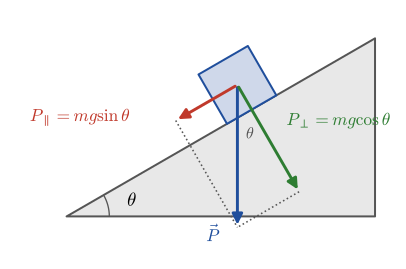 Scomposizione del peso su un piano inclinato. L’angolo tra e la perpendicolare al piano è uguale all’inclinazione .
Componenti del peso sul piano inclinato
- tira il corpo giù lungo il piano: è lei che lo fa scivolare se non c’è abbastanza attrito.
- preme il corpo contro il piano ed è bilanciata dalla reazione vincolare: (se non ci sono altre forze perpendicolari al piano).
I casi limite aiutano a ricordare quale componente ha il seno: per (piano orizzontale) e ; per (parete verticale) e .
Una cassa su una rampa
Una cassa di è su una rampa inclinata di . Quanto valgono le componenti del peso? Che forza serve per tenerla ferma, se non c’è attrito?
Soluzione
Il peso è ; la componente lungo la rampa è , quella perpendicolare . Per tenerla ferma senza attrito serve una forza di lungo la rampa, verso l’alto.
Tutti i dettagli sono nel capitolo dedicato al piano inclinato.
Collegamenti
Argomenti: Statica ed equilibrio Concetti: Forza peso · Forza normale Oggetti: Piano inclinato
Esercizi collegati: Esercizio svolto — Blocco appeso a due funi · Problema — Massa su piano liscio
Of all forces, the most familiar is weight: it is why objects fall and why a scale shows a reading when we step on it.
In short
The weight of a body of mass is the force with which the Earth attracts it: It points vertically downward, is measured in newtons (N), and at the Earth’s surface . A body weighs about .
Weight and mass are not the same thing
In everyday language “weight” and “mass” get mixed up (“I weigh 60 kilos”), but in physics they are two different quantities:
| Mass | Weight | |
|---|---|---|
| What it is | measure of the body’s inertia | attractive force of the Earth |
| Type | scalar | vector |
| Unit | kg | N |
| Instrument | balance | spring scale |
| Changes on the Moon? | no | yes, about 1/6 |
An astronaut has a mass of everywhere; their weight is on the Earth and on the Moon, where .
Are weight and the force of gravity the same thing?
Almost. Weight is the gravitational force the Earth exerts on a body near its surface. Universal gravitation gives, for a body of mass at the surface, So is the force of gravity written in a convenient form, valid as long as the body stays close to the Earth’s surface. (Strictly speaking, the measured value of also includes a small effect of the Earth’s rotation, and it varies slightly with latitude, between about and .) Moving away from the Earth the force of gravity decreases and with no longer holds: you will see this in the chapter on universal gravitation.
Weight is not the force the scale exerts
When you stand still on a scale, two forces act on you: your weight , downward, and the normal force from the platform, upward. They balance, but they are not an action–reaction pair: the reaction to your weight is the force with which you attract the Earth.
Weight on an inclined plane
On a plane inclined at an angle it is convenient to resolve the weight along two directions: parallel to the plane and perpendicular to the plane.
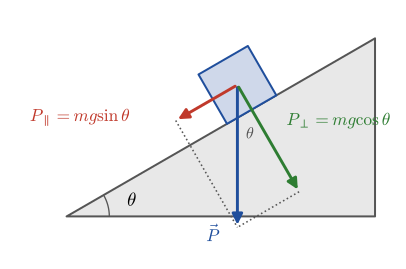 Resolving the weight on an inclined plane. The angle between and the normal to the plane equals the inclination .
Components of the weight on an inclined plane
- pulls the body down along the plane: it is what makes it slide if there is not enough friction.
- presses the body against the plane and is balanced by the normal force: (if no other forces act perpendicular to the plane).
The limiting cases help you remember which component has the sine: for (horizontal plane) and ; for (vertical wall) and .
A crate on a ramp
A crate sits on a ramp inclined at . What are the components of its weight? What force is needed to hold it still if there is no friction?
Solution
Its weight is ; the component along the ramp is , the perpendicular one . To hold it still without friction you need a force of up along the ramp.
Full details are in the chapter on the inclined plane.
Links
Topics: Statics and equilibrium Concepts: Weight · Normal force Objects: Inclined plane
Related exercises: Worked exercise — Block hanging from two ropes · Problem — Mass on a smooth plane