🧠 Mappa mentale e percorso di studio
Einstein e Infeld scrissero che la fisica è come un romanzo giallo: la Natura è il colpevole, lo scienziato il detective che ricostruisce i fatti dagli indizi (Einstein e Infeld 1938, cap. 1). Il moto è l’indizio più immediato. La cinematica è il ramo della fisica che descrive come si muovono i corpi, senza chiedersi perché: il perché sarà affidato alle forze, nel capitolo sulla dinamica. Questo capitolo introduce le grandezze del moto, il moto rettilineo uniforme, i grafici posizione-tempo e velocità-tempo, le equazioni del moto uniformemente accelerato, l’estensione ai vettori e al piano, e il moto circolare uniforme.
Sezioni
- Grandezze fondamentali del moto
- Conversione delle unità di misura
- Richiami di trigonometria
- Moto rettilineo uniforme
- Grafici del moto
- Moto rettilineo uniformemente accelerato
- Vettori e moto in due dimensioni
- Moto circolare uniforme
Riflessioni
Esercizi
Einstein and Infeld wrote that physics is like a detective novel: Nature is the culprit, the scientist the detective who reconstructs the facts from the clues (Einstein and Infeld 1938, ch. 1). Motion is the most immediate clue. Kinematics is the branch of physics that describes how bodies move, without asking why: the why will be left to forces, in the chapter on dynamics. This chapter introduces the quantities of motion, uniform rectilinear motion, the position-time and velocity-time graphs, the equations of uniformly accelerated motion, the extension to vectors and the plane, and uniform circular motion.
Sections
- Fundamental quantities of motion
- Unit conversion
- Trigonometry review
- Uniform rectilinear motion
- Graphs of motion
- Uniformly accelerated rectilinear motion
- Vectors and motion in two dimensions
- Uniform circular motion
Reflections
Exercises
Prima di risolvere qualsiasi problema è fondamentale lavorare in unità coerenti del Sistema Internazionale (SI). Le conversioni più utili in cinematica sono poche.
Conversioni chiave
Il trucco sistematico consiste nel moltiplicare per fattori di conversione, trasformando un’unità alla volta. Ogni fattore è un rapporto uguale a (per esempio ), quindi non altera il valore fisico, solo le unità con cui lo esprimiamo.
Esempio — Conversione di unità composte
Convertire in . Si noti che il metro al quadrato viene elevato al quadrato nel fattore di conversione, mentre il secondo viene convertito una sola volta.
Esempio — Conversione della forza
Convertire in .
Unità di misura nei calcoli
Non trascurare mai le unità di misura! Ogni risultato numerico senza unità è privo di significato fisico. Inoltre, controllare le unità del risultato è un potente strumento per verificare la correttezza dei calcoli.
Collegamenti
Argomenti: Grandezze fisiche e misura Competenze: Conversione di unità · Analisi dimensionale Metodi: Metodo dei fattori di conversione
Esercizi collegati: Esercizio svolto — Il rubinetto che perde · Esercizio svolto — Area di un rettangolo misurato · Problema — Volume di un parallelepipedo
Before solving any problem it is essential to work in consistent units of the International System (SI). The most useful conversions in kinematics are few.
Key conversions
The systematic trick consists in multiplying by conversion factors, transforming one unit at a time. Each factor is a ratio equal to (for example ), so it does not alter the physical value, only the units in which we express it.
Example — Conversion of compound units
Convert to . Note that the metre squared is squared in the conversion factor, while the second is converted only once.
Example — Conversion of force
Convert to .
Units of measurement in calculations
Never neglect units of measurement! Every numerical result without units is devoid of physical meaning. Moreover, checking the units of the result is a powerful tool for verifying the correctness of calculations.
Links
Topics: Physical quantities and measurement Skills: Unit conversion · Dimensional analysis Methods: Conversion factor method
Related exercises: Worked exercise — The leaking tap · Worked exercise — Area of a measured rectangle · Problem — Volume of a rectangular box
Un triangolo rettangolo e le sue relazioni sono la base di quasi ogni problema di fisica: servono ogni volta che dobbiamo scomporre una grandezza vettoriale nelle sue componenti.
Triangolo rettangolo: ipotenusa , cateto adiacente e cateto opposto rispetto all’angolo .
In un triangolo rettangolo con ipotenusa , cateto adiacente e cateto opposto rispetto all’angolo valgono le tre relazioni fondamentali:
Inversamente, noto un rapporto fra i lati si ricava l’angolo con le funzioni inverse:
Queste relazioni serviranno costantemente per passare dal modulo e dalla direzione di un vettore alle sue componenti cartesiane, e viceversa.
Collegamenti
Argomenti: Vettori Competenze: Uso della trigonometria · Scomposizione vettoriale
Esercizi collegati: Calciatore gittata e altezza massima · Il cane nel parco · Auto in curva
A right triangle and its relations are the basis of almost every physics problem: they are needed whenever we must resolve a vector quantity into its components.
Right triangle: hypotenuse , adjacent side and opposite side with respect to angle .
In a right triangle with hypotenuse , adjacent side and opposite side with respect to angle , the three fundamental relations hold:
Conversely, given a ratio between the sides, the angle can be found using the inverse functions:
These relations will be constantly needed to pass from the magnitude and direction of a vector to its Cartesian components, and vice versa.
Links
Topics: Vectors Skills: Use of trigonometry · Vector resolution
Related exercises: Footballer range and maximum height · The dog in the park · Car on a curve
Un corpo si muove di moto rettilineo uniforme quando percorre una retta a velocità costante. In ogni intervallo di tempo uguale copre lo stesso spostamento, e la velocità non cambia né in modulo né in verso. È il moto più semplice della cinematica, e il caso particolare del moto uniformemente accelerato in cui l’accelerazione è nulla.
Nel linguaggio di tutti i giorni «uniforme» e «costante» si usano quasi come sinonimi. In cinematica la parola ha un senso preciso: la velocità è la stessa in ogni istante, non solo in media. Un treno che viaggia a senza accelerare né frenare, un tapis roulant, un nastro trasportatore sono buoni modelli di moto rettilineo uniforme. Un’auto nel traffico, che frena e riparte, non lo è, anche se la velocità media sull’intero tragitto è un numero solo.
La posizione è una coordinata, non la strada percorsa. Si fissa un’origine sull’asse e un verso positivo. Se il corpo si muove nel verso positivo, è positiva; se torna indietro, è negativa e la posizione diminuisce. Due corpi possono avere la stessa velocità in modulo e muoversi in versi opposti: le loro velocità sono e , non lo stesso numero.
Legge oraria del moto rettilineo uniforme
Se all’istante il corpo si trova in e la velocità è costante, Le formule inverse, quelle che gli esercizi chiedono più spesso, sono L’accelerazione è nulla: . Unità SI: in metri, in secondi, in .
La legge oraria si legge così. In un tempo lo spostamento è . Si aggiunge alla posizione iniziale e si ottiene la posizione all’istante . Se la formula si riduce a , che è la versione da memorizzare per prima. Se il corpo parte da un’altra origine, o se l’orologio non parte quando il corpo è in , non si può omettere.
Velocità media e velocità istantanea qui coincidono. La velocità media su un intervallo è ; se non cambia, ogni intervallo dà lo stesso rapporto, e quel rapporto è anche la velocità in ciascun istante. Appena la velocità varia, le due grandezze si separano: la media descrive l’intervallo, l’istantanea descrive un istante. Il caso generale, con l’accelerazione diversa da zero, è nel capitolo sul moto rettilineo uniformemente accelerato.
I due grafici che lo riconoscono
Sul grafico posizione-tempo la legge è una retta. L’intercetta è , la posizione a . La pendenza è la velocità:
Una retta che sale ha : il corpo si muove nel verso positivo. Una retta che scende ha : il corpo si muove nel verso negativo. Una retta orizzontale ha : il corpo è fermo, che è il moto uniforme di velocità nulla. Più la retta è ripida, più è grande. Due corpi con la stessa pendenza hanno la stessa velocità, anche se le rette sono traslate l’una rispetto all’altra: la traslazione verticale cambia , non .
Sul grafico velocità-tempo il moto uniforme è una retta orizzontale, all’altezza . Il tempo scorre e la velocità non si alza né si abbassa. L’area compresa fra la retta e l’asse dei tempi, da a , è un rettangolo di base e altezza :
L’area è lo spostamento, con il segno. Se è negativa la retta sta sotto l’asse e l’area si conta negativa: il corpo si è spostato all’indietro. Questo è il caso più semplice di una regola che vale per ogni moto: l’area sotto il grafico – è lo spostamento. Come leggere pendenza e area anche quando i grafici non sono rette orizzontali è nella sezione sui grafici del moto.
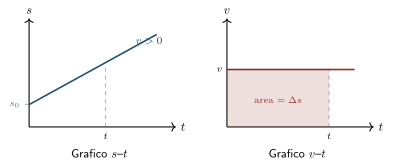
A sinistra la posizione cresce in modo lineare: la pendenza è . A destra la velocità è costante e l’area del rettangolo è lo spostamento.
Come si risolve un esercizio
Il procedimento è sempre lo stesso, e conviene scriverlo prima di sostituire i numeri.
- Si fissano origine e verso positivo, e si convertono i dati in metri e secondi. La conversione da a si fa dividendo per .
- Si scrive con i simboli, e si segna quale grandezza è l’incognita.
- Si ricava l’incognita e solo allora si sostituiscono i numeri, tenendo le cifre significative dei dati.
- Si controlla il segno e l’ordine di grandezza. Una persona a piedi sta intorno a , una bicicletta in città intorno a , un’auto in statale intorno a . Un risultato di per una passeggiata è il segnale di un’unità dimenticata.
Se due corpi si muovono sulla stessa retta, ciascuno ha la propria legge oraria. Si incontrano nell’istante in cui le due posizioni sono uguali: si uguagliano le due espressioni di e si risolve in .
Esercizi svolti
Esercizio 1 — Il tram in rettilineo
Un tram percorre un tratto rettilineo a velocità costante . All’istante si trova oltre la fermata presa come origine, e prosegue nel verso positivo. Dove si trova dopo ?
Prima la conversione, perché la legge oraria vuole i metri e i secondi: Il fattore è esatto, e ha due cifre significative, quindi con due cifre. La legge oraria dà Il tram è oltre la fermata. Il controllo è immediato: in a percorre , e .
Esercizio 2 — Quanto manca all'arrivo
Una ciclista viaggia a velocità costante nel verso positivo. La scuola, presa come origine, è alle sue spalle: all’istante la ciclista è già in . Il cancello del parco dista dalla scuola. Dopo quanti secondi ci arriva, e che velocità media ha sull’intero tratto?
La posizione del cancello del parco è . Dalla formula inversa Il dato meno preciso, , ha due cifre significative, e ne ha due. Lo spostamento è in , quindi Coincide con la velocità istantanea: è il marchio del moto uniforme. Se la ciclista avesse frenato a un semaforo, la media sarebbe stata minore della velocità tenuta nei tratti liberi.
Esercizio 3 — Due compagni sulla stessa retta
Anna parte dall’origine e cammina nel verso positivo a . Bruno parte dallo stesso punto dopo, e cammina nello stesso verso a . Dopo quanto tempo dall’istante in cui è partita Anna, Bruno la raggiunge? Dove?
Si misura il tempo dalla partenza di Anna. La sua legge oraria è . Bruno è fermo in origine per i primi ; per la sua legge è Si raggiungono quando : Si sviluppa: , quindi e La posizione è . Controllo con Bruno: ha camminato per a , cioè . I due conti coincidono. Le velocità hanno due cifre significative e i tempi dati sono esatti in questo problema, quindi e si riportano così come escono dal calcolo.
Errori tipici
- Usare i chilometri all’ora dentro . Se è in e in secondi, il prodotto non è in metri. Si converte prima, dividendo per , oppure si lavora tutto in chilometri e ore. Mescolare a metà conto è l’errore che sposta il risultato di un fattore .
- Confondere posizione e strada percorsa. Se un corpo va da a e torna a , lo spostamento è e la strada percorsa è . La legge oraria dà la posizione. La velocità del moto uniforme è spostamento su tempo, non strada su tempo: quest’ultima è la velocità scalare media, un’altra grandezza.
- Dimenticare o il ritardo di partenza. Se l’orologio non parte quando il corpo è nell’origine, la legge non è . Se un secondo corpo parte in ritardo, il suo tempo di moto è , non .
- Leggere la pendenza come un angolo in gradi. La pendenza del grafico – è , in . L’angolo che la retta forma con l’asse dipende dalla scala scelta per i due assi: cambiando la scala di un asse cambia l’angolo, ma non la velocità.
- Trattare un moto vario come se fosse uniforme. Una velocità media di non autorizza a dire che in ogni istante la velocità era . La legge vale solo se è costante. Per l’accelerazione costante si usano le quattro equazioni del moto uniformemente accelerato.
Collegamenti
Argomenti: Cinematica Concetti: Moto rettilineo uniforme · Velocità media
Vedi anche: Le quattro grandezze del moto · Grafici del moto · Moto rettilineo uniformemente accelerato · Treno a velocità costante
A body moves with uniform rectilinear motion when it travels along a straight line at constant velocity. In every equal time interval it covers the same displacement, and the velocity changes neither in magnitude nor in sense. It is the simplest motion in kinematics, and the special case of uniformly accelerated motion in which the acceleration is zero.
In everyday language “uniform” and “constant” are used almost as synonyms. In kinematics the word has a precise meaning: the velocity is the same at every instant, not only on average. A train travelling at without speeding up or braking, a treadmill, a conveyor belt are good models of uniform rectilinear motion. A car in traffic, braking and setting off again, is not, even if the average velocity over the whole journey is a single number.
The position is a coordinate, not the distance travelled. One fixes an origin on the axis and a positive sense. If the body moves in the positive sense, is positive; if it comes back, is negative and the position decreases. Two bodies can have the same speed and move in opposite senses: their velocities are and , not the same number.
Equation of motion for uniform rectilinear motion
If at the instant the body is at and the velocity is constant, The inverse formulae, the ones exercises ask for most often, are The acceleration is zero: . SI units: in metres, in seconds, in .
The equation of motion is read as follows. In a time the displacement is . One adds it to the initial position and obtains the position at time . If the formula reduces to , which is the version to memorise first. If the body starts from another origin, or if the clock does not start when the body is at , cannot be omitted.
Average velocity and instantaneous velocity coincide here. The average velocity over an interval is ; if does not change, every interval gives the same ratio, and that ratio is also the velocity at each instant. As soon as the velocity varies, the two quantities separate: the average describes the interval, the instantaneous value describes an instant. The general case, with non-zero acceleration, is in the chapter on uniformly accelerated rectilinear motion.
The two graphs that identify it
On the position-time graph the law is a straight line. The intercept is , the position at . The slope is the velocity:
A rising line has : the body moves in the positive sense. A falling line has : the body moves in the negative sense. A horizontal line has : the body is at rest, which is uniform motion of zero velocity. The steeper the line, the larger is. Two bodies with the same slope have the same velocity, even if the lines are shifted relative to each other: a vertical shift changes , not .
On the velocity-time graph uniform motion is a horizontal line, at height . Time passes and the velocity neither rises nor falls. The area between the line and the time axis, from to , is a rectangle of base and height :
The area is the displacement, with its sign. If is negative the line lies below the axis and the area is counted as negative: the body has moved backwards. This is the simplest case of a rule that holds for every motion: the area under the – graph is the displacement. How to read slope and area even when the graphs are not horizontal lines is in the section on graphs of motion.
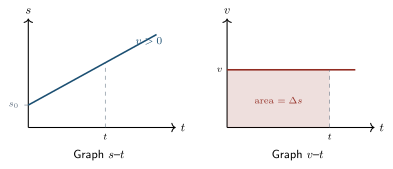
On the left the position grows linearly: the slope is . On the right the velocity is constant and the area of the rectangle is the displacement.
How to solve an exercise
The procedure is always the same, and it is worth writing it down before substituting the numbers.
- Fix the origin and the positive sense, and convert the data into metres and seconds. The conversion from to is done by dividing by .
- Write with symbols, and mark which quantity is the unknown.
- Solve for the unknown and only then substitute the numbers, keeping the significant figures of the data.
- Check the sign and the order of magnitude. A person on foot is around , a bicycle in town around , a car on a main road around . A result of for a walk is the sign of a forgotten unit.
If two bodies move on the same line, each has its own equation of motion. They meet at the instant when the two positions are equal: set the two expressions for equal and solve for .
Worked exercises
Exercise 1 — The tram on a straight stretch
A tram covers a straight stretch at constant velocity . At the instant it is past the stop taken as the origin, and it continues in the positive sense. Where is it after ?
First the conversion, because the equation of motion wants metres and seconds: The factor is exact, and has two significant figures, so to two figures. The equation of motion gives The tram is past the stop. The check is immediate: in at it covers , and .
Exercise 2 — How long until arrival
A cyclist travels at constant velocity in the positive sense. The school, taken as the origin, is behind her: at the instant the cyclist is already at . The park gate is from the school. After how many seconds does she arrive, and what average velocity does she have over the whole stretch?
The position of the park gate is . From the inverse formula The least precise datum, , has two significant figures, and has two. The displacement is in , so It coincides with the instantaneous velocity: that is the hallmark of uniform motion. If the cyclist had braked at a traffic light, the average would have been smaller than the velocity kept on the clear stretches.
Exercise 3 — Two classmates on the same line
Anna starts from the origin and walks in the positive sense at . Bruno starts from the same point later, and walks in the same sense at . How long after Anna set off does Bruno catch up with her? Where?
Time is measured from Anna’s start. Her equation of motion is . Bruno is at rest at the origin for the first ; for his equation is They meet when : Expanding: , so and The position is . Check with Bruno: he has walked for at , that is . The two calculations agree. The velocities have two significant figures and the times given are exact in this problem, so and are reported as they come out of the calculation.
Typical mistakes
- Using kilometres per hour inside . If is in and in seconds, the product is not in metres. Convert first, dividing by , or work entirely in kilometres and hours. Mixing halfway through is the mistake that shifts the result by a factor of .
- Confusing position and distance travelled. If a body goes from to and returns to , the displacement is and the distance travelled is . The equation of motion gives the position. The velocity of uniform motion is displacement over time, not distance over time: the latter is the average speed, a different quantity.
- Forgetting or a delayed start. If the clock does not start when the body is at the origin, the law is not . If a second body starts late, its time in motion is , not .
- Reading the slope as an angle in degrees. The slope of the – graph is , in . The angle the line makes with the axis depends on the scale chosen for the two axes: changing the scale of one axis changes the angle, but not the velocity.
- Treating a varying motion as if it were uniform. An average velocity of does not entitle one to say that at every instant the velocity was . The law holds only if is constant. For constant acceleration one uses the four equations of uniformly accelerated motion.
Links
Topics: Kinematics Concepts: Uniform rectilinear motion · Average velocity
See also: The four quantities of motion · Graphs of motion · Uniformly accelerated rectilinear motion · Train at constant velocity
Un grafico del moto non è un disegno della traiettoria. L’asse orizzontale è il tempo, l’asse verticale è una grandezza del moto: la posizione , la velocità o l’accelerazione . Una retta che sale nel grafico – non significa che il corpo va in salita; significa che la sua coordinata cresce al passare del tempo. Imparare a leggere questi grafici vale quanto imparare le formule, perché pendenza e area sono già le grandezze che le formule calcolano.
Qui si trattano i due grafici che servono in prima liceo, – e –, per il moto rettilineo uniforme e per il moto rettilineo uniformemente accelerato. Le definizioni di posizione, velocità e accelerazione stanno nelle quattro grandezze del moto; la legge sta nel moto rettilineo uniforme; le quattro equazioni con costante stanno nel moto uniformemente accelerato. Questa pagina non le ripete: dice come si vedono sul grafico.
Tre letture, sempre le stesse
Su qualunque grafico cartesiano di una grandezza in funzione del tempo si leggono tre cose.
| Quello che si guarda | Sul grafico – | Sul grafico – |
|---|---|---|
| Il valore sull’asse verticale | la posizione in quell’istante | la velocità in quell’istante |
| La pendenza della curva | la velocità | l’accelerazione |
| L’area fra la curva e l’asse | non è una grandezza che si usa in prima liceo | lo spostamento |
La pendenza fra due istanti è il rapporto incrementale. Fra e ,
Se il tratto è rettilineo, la pendenza è costante e la media coincide con il valore istantaneo. Se la curva si piega, la pendenza cambia da punto a punto e la media descrive solo l’intervallo.
L’area si conta con il segno. Sopra l’asse è positiva, sotto è negativa. Nel grafico – un’area positiva è uno spostamento nel verso positivo; un’area negativa è uno spostamento all’indietro. Se il corpo va avanti e poi torna, lo spostamento netto è la differenza delle due aree, mentre la strada percorsa è la somma dei loro valori assoluti.
Moto rettilineo uniforme
La velocità è costante, l’accelerazione è nulla.
- –: una retta. Intercetta , pendenza . Sale se , scende se , è orizzontale se il corpo è fermo.
- –: una retta orizzontale all’altezza . L’area da a è il rettangolo , cioè lo spostamento.
Due rette – con la stessa pendenza sono lo stesso moto traslato: i due corpi hanno la stessa velocità e posizioni iniziali diverse. Due rette con pendenze opposte sono due corpi che si muovono in versi opposti con lo stesso modulo di velocità. Si incontrano nel punto in cui le rette si incrociano, se l’incrocio cade nell’intervallo di tempo considerato: stessa posizione allo stesso istante.
Moto rettilineo uniformemente accelerato
Nel moto rettilineo uniformemente accelerato (MRUA) l’accelerazione è costante e diversa da zero. La velocità cresce o diminuisce in modo lineare,
e la posizione è
- –: una retta di pendenza e intercetta . Se la retta sale; se scende. Attraversa l’asse dei tempi nell’istante in cui il corpo si ferma e inverte il verso, se parte con velocità di segno opposto ad .
- –: un arco di parabola. Se la parabola è convessa (tiene l’acqua, come una U); se è concava (rovescia l’acqua, come una collina). Il vertice è l’istante in cui , perché lì la pendenza della – si annulla.
L’area sotto la retta – è un trapezio, o un triangolo se si parte da fermi. Per un corpo che parte con velocità e arriva con velocità ,
È la terza delle quattro equazioni del moto uniformemente accelerato, letta come area: la base è , l’altezza media è . Partendo da fermo, e , l’area del triangolo è
che è la legge oraria con . Il grafico e la formula dicono la stessa cosa.
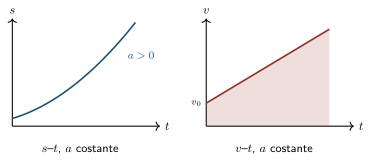
Con la posizione è un arco di parabola e la velocità è una retta che sale. L’area sotto la retta è lo spostamento.
Come si costruisce un grafico a partire da una tabella
Si parte dalla tabella degli eventi: pochi istanti, e per ciascuno posizione o velocità. Poi si riconosce il tipo di moto e si completa la curva, senza inventare gobbe fra un punto e l’altro.
- Si scelgono le scale in modo che i dati occupino il foglio, e si scrivono le unità sugli assi. Un secondo e un metro non sono obbligati ad avere la stessa lunghezza sul disegno.
- Si riportano i punti. Per un moto uniforme fra due eventi bastano i due estremi: la – è il segmento che li unisce, la – è orizzontale.
- Per un MRUA si riportano velocità iniziale e finale sulla – e si traccia la retta. La – non si traccia unendo i punti con segmenti spezzati, se l’accelerazione è costante per tutto il tratto: fra i punti la curva è un arco di parabola, più ripido dove è maggiore.
- Si legge la pendenza su un intervallo largo, non su due punti vicini. con un di pochi millimetri di disegno amplifica l’errore di lettura.
Un tratto a velocità costante seguito da una frenata costante si disegna a pezzi. Sulla – si vede un segmento orizzontale e poi un segmento che scende fino a zero. Sulla – si vede una retta e poi un arco di parabola che si appiattisce quando il corpo si ferma. Il punto di raccordo ha la stessa posizione e la stessa velocità nei due tratti: la curva – non ha uno spigolo, perché uno spigolo sarebbe un salto di velocità.
Esercizi svolti
Esercizio 1 — Velocità dalla pendenza
Sul grafico – di un moto uniforme la retta passa per i punti e . Qual è la velocità? Qual era la posizione a , se il moto era uniforme anche prima di ?
La pendenza è la velocità: Il dato meno preciso ha due cifre significative e il quoziente è esatto, quindi . Fra e lo spostamento è , dunque Controllo con la legge oraria a : , che è il secondo punto.
Esercizio 2 — Spostamento dall'area
Il grafico – di un’auto è una retta orizzontale a da a , poi una retta che scende fino a a . Quanto vale lo spostamento totale? Quanto vale l’accelerazione nel secondo tratto?
Primo tratto: rettangolo di base e altezza , Secondo tratto: triangolo di base e altezza , Lo spostamento totale è I dati hanno due cifre significative; ne ha due. L’accelerazione nel secondo tratto è la pendenza della –: Il segno meno dice che la velocità diminuisce: è una frenata. Il modulo è quello di una frenata decisa, ma lontana da una inchiodata, che sull’asfalto asciutto arriva intorno a .
Esercizio 3 — Riconoscere la parabola
Un corpo parte da fermo in con accelerazione costante , verso positivo. Calcola posizione e velocità a , e , e spiega perché i punti della – non stanno su una retta.
Con e le leggi sono e .
(s) (m/s) (m) Poiché , la posizione è proprio , e i tre valori sono esatti con le due cifre dei dati. Sulla – i tre punti stanno su una retta di pendenza . Sulla – gli incrementi di posizione non sono uguali: nel primo secondo, nel secondo, nel terzo. Una retta avrebbe incrementi uguali in tempi uguali. La pendenza cresce perché cresce la velocità: è il segno grafico della parabola del MRUA.
Controllo con l’area. Fra e la – è un triangolo di base e altezza : l’area è , uguale alla posizione letta sulla tabella.
Errori tipici
- Scambiare il grafico con la mappa. Una curva sul grafico – non è una curva della strada. Il moto di queste pagine è rettilineo anche quando il grafico è una parabola: la parabola sta nel piano , non sulla traiettoria.
- Leggere l’altezza della – come una velocità. L’altezza è la posizione. La velocità è la pendenza. Un corpo può essere lontano dall’origine e avere velocità piccola: retta alta, poco inclinata.
- Dimenticare il segno dell’area. Se la retta – attraversa l’asse, l’area sotto l’asse va sottratta. Sommare i valori assoluti dà la strada percorsa, non lo spostamento.
- Unire i punti del MRUA con una spezzata. Fra due eventi di un moto ad accelerazione costante la – è un arco di parabola. I segmenti vanno bene solo se in quell’intervallo la velocità è costante.
- Confondere pendenza della – e area della –. La pendenza è l’accelerazione, in . L’area è lo spostamento, in metri. Hanno unità diverse: se il numero che si ottiene non ha l’unità della grandezza cercata, si è letta la cosa sbagliata.
Collegamenti
Argomenti: Cinematica Concetti: Moto rettilineo uniforme · Moto uniformemente accelerato · Velocità media · Accelerazione Competenze: Lettura dei grafici
Vedi anche: Moto rettilineo uniforme · Le quattro equazioni fondamentali · Distanza dall’area del grafico v-t · Accelerazione dal grafico v(t)
A graph of motion is not a drawing of the trajectory. The horizontal axis is time, the vertical axis is a quantity of motion: the position , the velocity or the acceleration . A rising line on the – graph does not mean that the body is going uphill; it means that its coordinate increases as time passes. Learning to read these graphs is worth as much as learning the formulae, because slope and area are already the quantities that the formulae calculate.
Here we treat the two graphs needed in the first year, – and –, for uniform rectilinear motion and for uniformly accelerated rectilinear motion. The definitions of position, velocity and acceleration are in the four quantities of motion; the law is in uniform rectilinear motion; the four equations with constant are in uniformly accelerated motion. This page does not repeat them: it says how they look on a graph.
Three readings, always the same
On any Cartesian graph of a quantity as a function of time one reads three things.
| What one looks at | On the – graph | On the – graph |
|---|---|---|
| The value on the vertical axis | the position at that instant | the velocity at that instant |
| The slope of the curve | the velocity | the acceleration |
| The area between the curve and the axis | not a quantity used in the first year | the displacement |
The slope between two instants is the difference quotient. Between and ,
If the stretch is straight, the slope is constant and the average coincides with the instantaneous value. If the curve bends, the slope changes from point to point and the average describes only the interval.
Area is counted with its sign. Above the axis it is positive, below it is negative. On the – graph a positive area is a displacement in the positive sense; a negative area is a displacement backwards. If the body goes forward and then returns, the net displacement is the difference of the two areas, while the distance travelled is the sum of their absolute values.
Uniform rectilinear motion
The velocity is constant, the acceleration is zero.
- –: a straight line. Intercept , slope . It rises if , falls if , and is horizontal if the body is at rest.
- –: a horizontal line at height . The area from to is the rectangle , that is the displacement.
Two – lines with the same slope are the same motion shifted: the two bodies have the same velocity and different initial positions. Two lines with opposite slopes are two bodies moving in opposite senses with the same speed. They meet at the point where the lines cross, if the crossing falls within the time interval considered: same position at the same instant.
Uniformly accelerated rectilinear motion
The acceleration is constant and non-zero. The velocity grows or decreases linearly,
and the position is
- –: a straight line of slope and intercept . If the line rises; if it falls. It crosses the time axis at the instant when the body stops and reverses its sense, if it starts with a velocity of opposite sign to .
- –: an arc of a parabola. If the parabola is convex (it holds water, like a U); if it is concave (it spills water, like a hill). The vertex is the instant at which , because there the slope of the – graph vanishes.
The area under the – line is a trapezium, or a triangle if one starts from rest. For a body that starts with velocity and arrives with velocity ,
It is the third of the four equations of uniformly accelerated motion, read as an area: the base is , the average height is . Starting from rest, and , the area of the triangle is
which is the equation of motion with . The graph and the formula say the same thing.
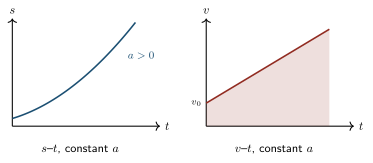
With the position is an arc of a parabola and the velocity is a rising line. The area under the line is the displacement.
How to build a graph from a table
One starts from the table of events: a few instants, and for each a position or a velocity. Then one recognises the type of motion and completes the curve, without inventing bumps between one point and the next.
- Choose the scales so that the data fill the page, and write the units on the axes. One second and one metre are not obliged to have the same length on the drawing.
- Plot the points. For uniform motion between two events the two endpoints are enough: the – graph is the segment that joins them, the – graph is horizontal.
- For uniformly accelerated motion, plot the initial and final velocities on the – graph and draw the line. The – graph is not drawn by joining the points with broken segments, if the acceleration is constant over the whole stretch: between the points the curve is an arc of a parabola, steeper where is larger.
- Read the slope over a wide interval, not over two nearby points. with a of a few millimetres on the drawing amplifies the reading error.
A stretch at constant velocity followed by a constant braking is drawn in pieces. On the – graph one sees a horizontal segment and then a segment that falls to zero. On the – graph one sees a straight line and then an arc of a parabola that flattens when the body stops. The joining point has the same position and the same velocity in the two stretches: the – curve has no corner, because a corner would be a jump in velocity.
Worked exercises
Exercise 1 — Velocity from the slope
On the – graph of a uniform motion the line passes through the points and . What is the velocity? What was the position at , if the motion was uniform even before ?
The slope is the velocity: The least precise datum has two significant figures and the quotient is exact, so . Between and the displacement is , hence Check with the equation of motion at : , which is the second point.
Exercise 2 — Displacement from the area
The – graph of a car is a horizontal line at from to , then a line that falls to at . What is the total displacement? What is the acceleration in the second stretch?
First stretch: a rectangle of base and height , Second stretch: a triangle of base and height , The total displacement is The data have two significant figures; has two. The acceleration in the second stretch is the slope of the – graph: The minus sign says that the velocity decreases: it is a braking. The magnitude is that of a firm braking, but far from an emergency stop, which on dry asphalt reaches about .
Exercise 3 — Recognising the parabola
A body starts from rest at with constant acceleration , positive sense. Calculate position and velocity at , and , and explain why the points of the – graph do not lie on a straight line.
With and the laws are and .
(s) (m/s) (m) Since , the position is exactly , and the three values are exact to the two figures of the data. On the – graph the three points lie on a line of slope . On the – graph the increments of position are not equal: in the first second, in the second, in the third. A straight line would have equal increments in equal times. The slope increases because the velocity increases: that is the graphical sign of the parabola of uniformly accelerated motion.
Check with the area. Between and the – graph is a triangle of base and height : the area is , equal to the position read from the table.
Typical mistakes
- Confusing the graph with the map. A curve on the – graph is not a curve in the road. The motion on these pages is rectilinear even when the graph is a parabola: the parabola lies in the plane, not on the trajectory.
- Reading the height of the – graph as a velocity. The height is the position. The velocity is the slope. A body can be far from the origin and have a small velocity: a high line, slightly inclined.
- Forgetting the sign of the area. If the – line crosses the axis, the area below the axis must be subtracted. Adding the absolute values gives the distance travelled, not the displacement.
- Joining the points of uniformly accelerated motion with a broken line. Between two events of a motion with constant acceleration the – graph is an arc of a parabola. Segments are appropriate only if the velocity is constant in that interval.
- Confusing the slope of the – graph and the area of the – graph. The slope is the acceleration, in . The area is the displacement, in metres. They have different units: if the number one obtains does not have the unit of the quantity sought, one has read the wrong thing.
Links
Topics: Kinematics Concepts: Uniform rectilinear motion · Uniformly accelerated motion · Average velocity · Acceleration Skills: Reading graphs
See also: Uniform rectilinear motion · The four fundamental equations · Distance from the area of the v-t graph · Acceleration from the v(t) graph
Scrivere sembra un gesto innocente. In realtà nasconde una scelta decisiva: quando comincia ""? Abbiamo fissato un istante zero, un’origine dei tempi, e un punto zero, un’origine degli spazi, e solo rispetto a essi misuriamo le posizioni.
La stessa realtà fisica — una macchina che corre per secondi — può essere scritta in mille modi diversi a seconda di dove abbiamo piantato i due paletti. Se sposto l’origine degli spazi, cambiano tutti i valori di ; se sposto l’origine dei tempi, cambiano tutti i valori di . Eppure il moto, quello vero, è sempre lo stesso: la macchina non sa dove abbiamo messo lo zero.
Questo semplice fatto contiene già il seme del principio di relatività: le leggi della fisica devono avere la stessa forma qualunque sia il paletto che abbiamo scelto, purché sia un sistema di riferimento inerziale. La libertà di scegliere l’origine non è un difetto della descrizione, ma un indizio di una simmetria profonda della natura.

Collegamenti
Argomenti: Cinematica Concetti: Moto uniformemente accelerato
Esercizi collegati: Il viaggio di Carlo · Distanza di arresto (reazione e frenata) · Dimostrazione dell’equazione senza tempo
Writing seems an innocent gesture. In reality it hides a decisive choice: when does "" begin? We have fixed a zero instant, an origin of times, and a zero point, an origin of positions, and only with respect to them do we measure positions.
The same physical reality — a car travelling for seconds — can be written in a thousand different ways depending on where we have planted the two markers. If I shift the origin of positions, all the values of change; if I shift the origin of times, all the values of change. Yet the motion, the real one, is always the same: the car does not know where we have put the zero.
This simple fact already contains the seed of the principle of relativity: the laws of physics must have the same form whatever marker we have chosen, provided it is an inertial reference frame. The freedom to choose the origin is not a flaw in the description, but a clue to a deep symmetry of nature.
Links
Topics: Kinematics Concepts: Uniformly accelerated motion
Related exercises: Carlo’s journey · Stopping distance (reaction and braking) · Proof of the time-independent equation